
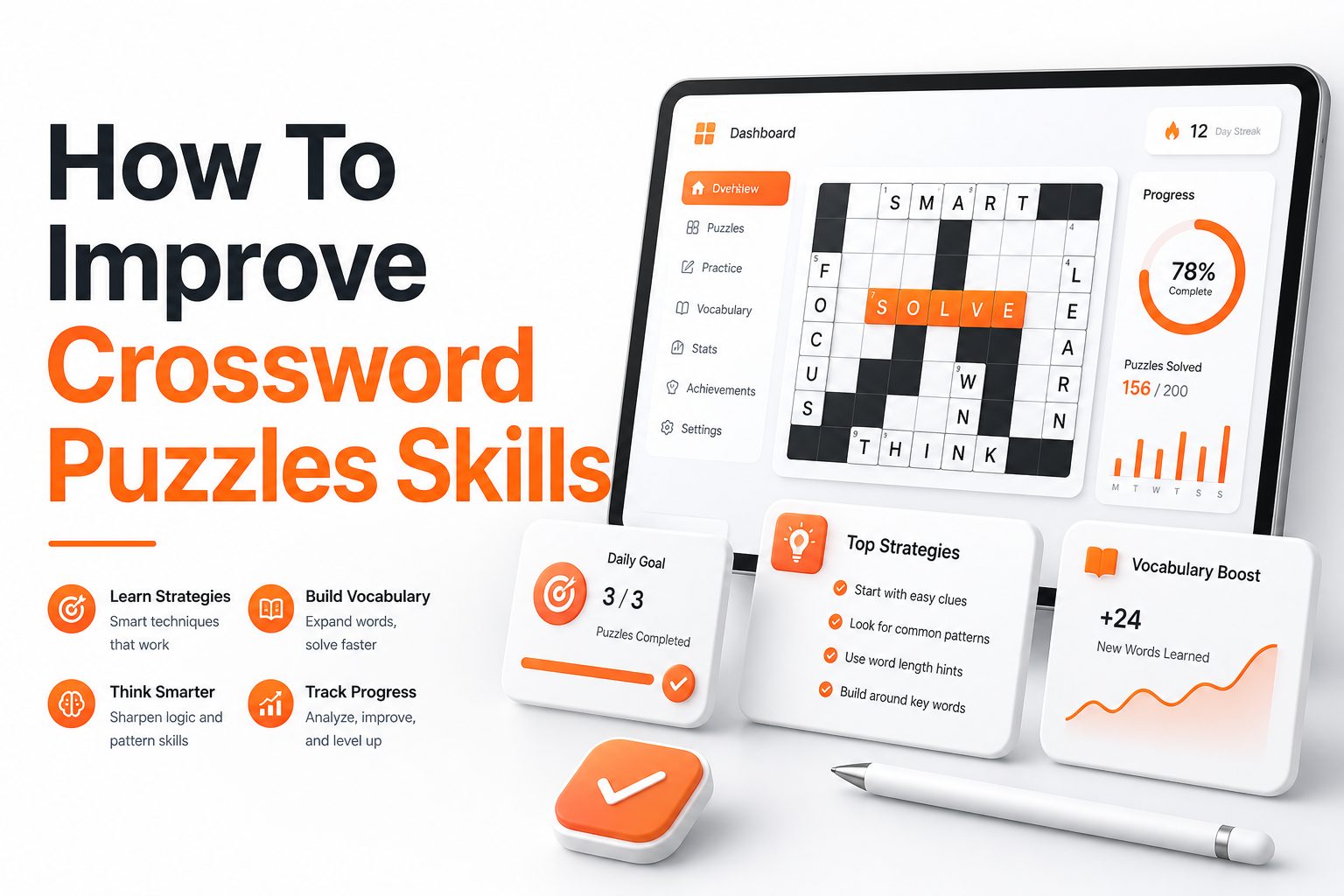
Crossword puzzles look simple until a blank grid refuses to give you even one friendly answer. That is part of their charm. A good crossword asks you to notice language, spot patterns, recall facts, and think sideways all at once. Some clues reward knowledge, while others reward patience and flexible thinking.
If you want to know how to improve crossword puzzles skills, the best approach is not memorizing random facts or forcing yourself through impossible grids. Real progress comes from building better solving habits, learning common clue styles, and practicing with puzzles that stretch you without leaving you stuck. With the right methods, each puzzle becomes less frustrating and more satisfying. You begin to recognize tricks, trust partial answers, and use crossings more confidently. This guide will show you practical ways to sharpen your crossword solving, whether you are a casual weekend solver or someone who wants to tackle tougher daily puzzles.
Build a Consistent Crossword Habit
Improvement starts with regular exposure. Solving one puzzle every few weeks will not build the same instincts as working on a grid for ten or fifteen minutes most days. Crossword skills grow through repetition because clue patterns, answer styles, and wordplay become familiar over time.
Choose puzzles that match your current level, then raise the difficulty gradually. Early-week newspaper crosswords, mini puzzles, and beginner-friendly themed grids are useful starting points. If every clue feels impossible, the puzzle is too advanced for practice. You want enough challenge to learn, not constant discouragement.
Start With the Easiest Clues First
Strong solvers rarely complete a crossword in perfect order. They scan the grid and collect quick wins first. Fill-in-the-blank clues, direct definitions, abbreviations, plurals, and short common answers can give you early letters that make harder clues easier to solve.
This approach builds momentum. A single confirmed answer can reveal two or three crossing letters, turning vague clues into solvable ones. When you get stuck, move on rather than staring at one clue too long. Fresh letters often do more than forced thinking.
Quick Starter Habits
- Scan the full clue list before committing to difficult answers.
- Fill obvious short answers first.
- Mark clues that feel solvable but need crossing letters.
- Return to stuck areas after completing another part of the grid.
- Treat every confirmed letter as useful evidence.
Learn Common Crossword Clue Types
Crossword clues follow patterns. Some are straightforward definitions, while others use wordplay, abbreviations, puns, foreign words, initials, or hidden meanings. Once you know the clue type, you can solve faster because you are asking the right kind of question.
For example, a clue ending with “maybe” or “for one” often points to an example rather than a broad category. A clue with an abbreviation usually expects an abbreviated answer. Learning these conventions is one of the most reliable ways to improve crossword puzzle solving.
Use Crossings Before Guessing
Crossing answers are the built-in safety system of every crossword. Instead of guessing a full answer from a clue you only half understand, use intersecting letters to narrow the possibilities. This reduces mistakes and helps you see answers you might not recall immediately.
If you have three letters in a five-letter answer, say _ A _ E R, your brain has much more to work with. Crossings also help confirm tricky spellings, names, and themed entries. Good solvers lean on the grid instead of relying only on memory.
Common Clue Types and What They Signal
Clue Type | What It Often Means | Example Approach
Fill-in-the-blank | Usually direct and easier | Solve early for quick letters
Abbreviation clue | Answer may be shortened | Look for initials or common short forms
Question-style clue | Wordplay or pun likely | Think beyond the literal meaning
Plural clue | Answer is usually plural | Check for S or ES endings
“Maybe” clue | Example, not definition | Think of one item in a category
Expand Your Crossword Vocabulary
Crosswords have a vocabulary of their own. You will see common short words, older terms, Roman numerals, compass points, musical notes, airport codes, literary names, and repeated abbreviations. These answers appear because they fit grids well, not always because they are common in speech.
Keep a small list of words that appear often and trip you up. Entries like “aria,” “erne,” “olio,” “epee,” and “etna” may feel strange at first, but repeated exposure makes them automatic. This is not cheating; it is learning the language of the puzzle.
Read More Widely for Better Recall
General knowledge helps, especially in larger or more advanced crosswords. Reading news, books, essays, film reviews, sports summaries, and cultural pieces gives your brain more reference points. You do not need expert knowledge in every subject, but a broad base makes clues less intimidating.
Crosswords reward flexible recall. A clue may reference mythology one day and baseball the next. Reading across topics builds the mental shelves where answers can live. Even light, consistent reading improves your ability to recognize names, places, phrases, and idioms.
Vocabulary-Building Checklist
- Save unfamiliar crossword answers in a notes app.
- Review repeated short answers once a week.
- Read clue explanations after solving.
- Learn common abbreviations used in puzzles.
- Pay attention to word endings, prefixes, and suffixes.
- Add new names, places, and terms without trying to memorize everything at once.
Pay Attention to Tense and Grammar
Clues and answers must match grammatically. If a clue is past tense, the answer is usually past tense. If the clue is a noun, the answer is usually a noun. If the clue uses informal language, the answer may be informal too.
This simple rule eliminates many wrong guesses. For instance, “Ran quickly” is unlikely to be “dash” because the tense does not match. “Ran quickly” might be “sped.” Grammar is one of the quiet tools that separates random guessing from skilled solving.
Notice Plurals, Comparatives, and Verb Forms
Small word endings matter. A plural clue often leads to a plural answer, while “better” may signal a comparative form. A clue like “moves slowly” might end in S because the subject is third person. These details guide your answer shape.
Crossword constructors use grammar carefully, especially in well-edited puzzles. When an answer feels close but does not match the clue’s form, treat that mismatch as a warning. The right answer usually fits both meaning and grammar cleanly.
Practice With Themed Puzzles
Many crosswords have themes, especially daily newspaper puzzles. The longest answers often share a pattern, pun, phrase structure, or hidden element. Once you identify the theme, several difficult entries may become much easier to solve.
Do not ignore the title if the puzzle has one. Titles often hint at the theme. If several long answers seem odd, they may be modified phrases. Learning to spot themes helps you read the puzzle as a whole instead of treating every clue separately.
Use the Theme to Break Open Hard Areas
A theme can rescue a stuck grid. Suppose three long answers all involve missing letters, food puns, or phrases with changed endings. Once you catch the trick, you can predict the remaining theme answers more confidently.
This is especially useful for solvers learning how to improve crossword puzzles skills because themes teach lateral thinking. They show how constructors bend language while still following rules. Over time, you begin looking for the puzzle’s central idea earlier.
Theme-Solving Tips
1. Look at the longest answers first after filling easy clues.
2. Check whether long answers share word lengths or phrase patterns.
3. Read the puzzle title for hints.
4. Compare unusual answers instead of treating them as mistakes.
5. Use one solved theme answer to predict another.
Get Comfortable With Wordplay
Crossword wordplay can feel unfair until you learn its habits. A clue may use a word’s secondary meaning, treat a phrase literally, or hide a small joke. The answer is still logical, but the route to it is less direct than a dictionary definition.
When a clue sounds too simple, be cautious. “Flower” might mean something that flows, such as a river, not a plant. “Capital” might refer to money or a city. Skilled solvers pause long enough to test alternate meanings before filling an answer.
Train Yourself to Think Sideways
One useful exercise is reading a clue and asking, “What else could this word mean?” This habit turns frustration into investigation. You start noticing verbs disguised as nouns, nouns disguised as adjectives, and ordinary words used in technical ways.
Humor also matters. Many clever clues rely on a small twist. If an answer makes you smile after you see it, remember the mechanism. Similar tricks will appear again, and your reaction time will improve with practice.
Review Completed Puzzles
The best learning often happens after the grid is filled. Take five minutes to review clues you missed, guessed, or solved only through crossings. Ask why the answer worked. Was it a pun, abbreviation, cultural reference, or grammar clue?
This habit turns every puzzle into a lesson. Without review, you may repeat the same mistakes for months. With review, you build a memory bank of clue styles and answers. For related practice ideas, see [Internal Link: Crossword Puzzle Solving Strategies].
Keep a Mistake Log
A mistake log does not need to be formal. Write down the clue, the correct answer, and the reason you missed it. Patterns will emerge quickly. You may struggle with sports clues, foreign words, pop culture, or hidden abbreviations.
Once you know your weak areas, practice becomes targeted. Instead of vaguely trying to “get better,” you can review common opera terms, U.S. state abbreviations, Greek letters, or literary names. Targeted review saves time and builds confidence.
What to Review After Each Puzzle
Item to Check | Why It Matters
Wrong answers | Shows where assumptions misled you
Blank clues | Reveals knowledge gaps or clue styles to study
Guessed entries | Helps confirm whether your logic was sound
Theme answers | Builds pattern recognition
Repeated answers | Adds useful crossword vocabulary
Choose the Right Difficulty Level
A puzzle should challenge you, but it should also give you a way in. If you cannot solve more than a handful of clues without help, switch to an easier puzzle for a while. Skill grows best when effort produces feedback.
Many publishers increase difficulty throughout the week. Monday puzzles are often more direct, while later-week puzzles use trickier wordplay. Start where you can finish with light help, then move up when your completion rate improves.
Mix Easy and Hard Puzzles
Easy puzzles build speed and pattern recognition. Hard puzzles build patience and flexibility. A smart practice routine includes both. You might solve easier puzzles during the week and spend more time with one challenging puzzle on the weekend.
This balance prevents burnout. Constantly solving only easy puzzles may slow your growth, while only attempting hard puzzles can become discouraging. The right mix keeps your brain active without turning crosswords into a chore.
Use Help Strategically
Looking up an answer is not a failure if you use it well. The problem is copying answers without learning from them. Strategic help means checking one crossing, confirming a proper noun, or reading an explanation after making a real attempt.
Set a personal rule before you start. For example, solve for fifteen minutes before using help, or reveal one letter only after exhausting the crossings. Boundaries keep assistance useful and prevent it from replacing your own reasoning.
Learn From Explanations, Not Just Answers
Many crossword apps and blogs explain tricky clues. These explanations are valuable because they show the path from clue to answer. A bare answer may fill the grid, but the explanation improves your future solving.
When reviewing help, focus on the clue mechanism. Was the answer an abbreviation? A homophone? A pun? A hidden definition? This turns outside help into skill-building rather than simple answer-finding. You can also use [Internal Link: Word Games and Brain Training] for wider practice.
Smart Help Rules
- Try all obvious crossings before revealing anything.
- Reveal a letter before revealing a full word.
- Look up obscure facts after making a serious attempt.
- Read clue explanations whenever available.
- Re-solve missed clues later without looking at the answers.
- Avoid using help so early that the puzzle never challenges you.
Practice Pattern Recognition
Crossword solving relies heavily on pattern recognition. Letter shapes, common endings, repeated clue formulas, and familiar answer lengths all guide you. The more puzzles you solve, the faster your brain recognizes likely answers from partial information.
For example, a three-letter opera solo is often “aria.” A four-letter fencing sword is often “epee.” These repeated entries are not shortcuts for lazy solving. They are part of the crossword ecosystem, and knowing them frees mental energy for harder clues.
Use Letter Patterns Actively
When you have partial letters, say the pattern out loud or write possible answers nearby. A pattern like S _ E _ D can lead to “speed,” “spend,” or “stead,” depending on the clue. Testing possibilities against crossings sharpens your logic.
Pattern work is especially helpful for longer phrases. You may recognize a common expression from just a few letters. This is one reason experienced solvers seem fast: they are not solving every clue from scratch. They are matching patterns efficiently.
Improve Your Clue Reading
Many wrong answers come from reading too quickly. A clue may contain a small signal that changes everything: abbreviation, tense, quotation marks, slang, capitalization, or a hint that the answer is an example. Slow reading prevents avoidable mistakes.
Before filling a tricky answer, check the clue’s exact wording. If the clue says “briefly,” the answer may be shortened. If it says “in Madrid,” the answer may be Spanish. These small directions are easy to miss but very useful.
Watch for Misdirection
Misdirection is part of the fun. A clue may look like it belongs to one subject but point somewhere else. “Pitcher’s stat” could involve baseball, but “pitcher” might also mean a container. The clue is fair if the answer fits the wording.
Train yourself to separate assumptions from evidence. If your first interpretation stalls, change the frame. Ask whether the clue uses a different part of speech, a less common meaning, or a familiar phrase in an unusual way.
Clue Reading Reminders
1. Check tense before guessing.
2. Notice abbreviations in the clue.
3. Treat quotation marks as tone or speech signals.
4. Watch for language hints such as “in Paris” or “to Caesar.”
5. Reconsider any clue that feels too obvious in a hard puzzle.
Build Speed Without Rushing
Speed comes from accuracy and familiarity, not panic. If you try to solve too quickly before your foundation is strong, you will fill the grid with weak guesses and spend extra time correcting them. Clean solving is usually faster than reckless solving.
Time yourself occasionally, but do not make every puzzle a race. Use timing to measure progress, not to pressure yourself. A better goal is finishing with fewer mistakes, recognizing more clue types, and needing less help over several weeks.
Develop a Personal Solving Routine
A repeatable routine reduces wasted effort. Start with easy clues, fill crossings, identify theme entries, review hard sections, and save lookups for later. This rhythm keeps you moving even when one corner of the grid resists.
Your routine may change with experience. Some solvers attack long answers early, while others prefer short fill. The key is having a method instead of bouncing randomly. A steady process makes difficult puzzles feel more manageable.
Conclusion
Getting better at crosswords is a mix of habit, patience, and sharper attention to language. You do not need to know every trivia answer or solve every grid without help. What matters is learning how clues work, using crossings wisely, reviewing mistakes, and choosing puzzles that challenge you at the right level.
The more you practice, the more familiar the patterns become. Common crossword words stop feeling strange. Wordplay becomes less intimidating. Themes begin to reveal themselves sooner. Even your wrong guesses become useful when you review them carefully. If your goal is how to improve crossword puzzles skills, focus on steady practice rather than instant mastery. Ten thoughtful minutes a day can do more than one long, frustrating session each month. Over time, the blank grid feels less like a wall and more like an invitation to think clearly, play with language, and enjoy the satisfaction of each answer falling into place.
FAQ
How long does it take to get better at crossword puzzles?
Most solvers notice progress within a few weeks of regular practice. Daily short sessions build clue familiarity, vocabulary, and confidence. Larger gains usually come after several months of solving, reviewing mistakes, and trying slightly harder puzzles.
Are crossword puzzles good for vocabulary?
Yes, crosswords can improve vocabulary by exposing you to synonyms, idioms, abbreviations, older terms, and subject-specific words. The benefit is strongest when you review unfamiliar answers instead of simply filling them and moving on.
Should beginners use crossword solving apps?
Crossword apps are useful for beginners because they offer hints, error checking, and puzzles at different difficulty levels. Use those tools sparingly so they support learning without replacing your own problem-solving process.
What is the best way to solve hard crossword clues?
Use crossing letters first, then check grammar, tense, clue type, and possible wordplay. If the clue still resists, move to another area of the grid. Returning later with more letters often makes the answer clearer.
Do crossword puzzles require strong general knowledge?
General knowledge helps, but it is not the only skill. Clue reading, pattern recognition, vocabulary, and logic matter just as much. Beginners can improve quickly by learning crossword conventions and practicing with well-matched puzzles.
0 Comments